Your Comprehensive Guide to Pen Evolution Through History
From the word go, I’ve been fascinated with pens and their evolution. It’s not just ink on paper; it’s a testament to human innovation.
In this guide, I’ll walk you through the ages, from the rudimentary tools wielded by ancient scribes, to the elegance of quills, the practicality of fountain and ballpoint pens, and finally, the sophistication of digital pens.
So let’s dive in, and unravel the fascinating journey of pens throughout history.
Ancient Scribes: Early Writing Tools
Diving into the origins of pens, I’m struck by the ingenuity of ancient scribes and their early writing tools. Clay tablet etching was one such method, where symbols were meticulously carved onto wet clay tablets, which then hardened to preserve the message. This process required a keen eye, steady hand, and a profound understanding of the symbolic language being etched.
Moving forward, the reed pen usage marked a significant leap in writing technology. These pens, made from a single reed straw, had a split nib that held ink. This enabled smoother, more fluid writing that we’d recognize today. Their use spread across Egypt and Greece, revolutionizing the way humans record information.
It’s fascinating to see how far we’ve come from etching clay tablets to the modern pens we use today.
Middle Ages: The Quill Emerges
Transitioning into the Middle Ages, there’s an impressive shift in writing tools again with the emergence of the quill pen. This marked a significant advancement in writing technology, and quill crafting techniques evolved to meet the demand.
To paint a clearer picture, let’s delve into these aspects:
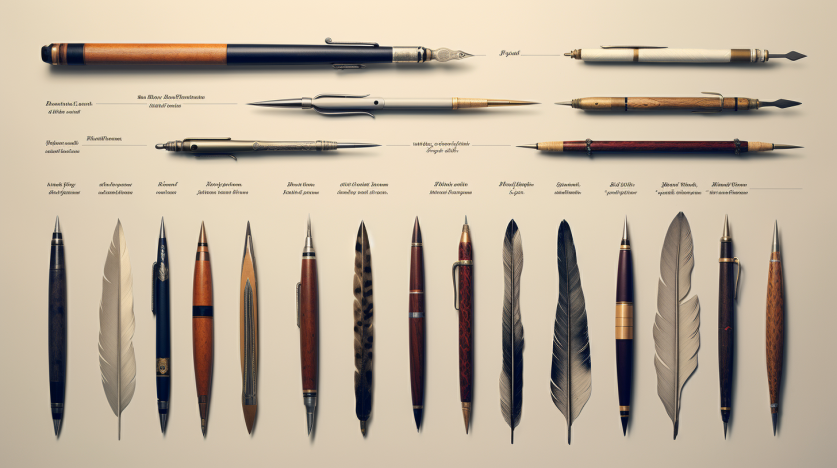
- Quills were usually made from goose feathers, carefully crafted by removing the feather’s barbs.
- Ink was produced from a variety of sources, including plant extracts and even iron salts!
- Quills were highly flexible, offering a greater range of artistic expression than previous tools.
- Despite the advent of the quill pen, Medieval literacy rates remained low, with writing skills often confined to clergy and the elite.
The quill, thus, played a pivotal role in the history of writing instruments.
Industrial Revolution: Invention of Fountain Pens
Moving on from quills, I’m now turning to the Industrial Revolution, a time that saw the invention of the fountain pen, revolutionizing how we write once again. The fountain pen’s mechanics were a game-changer, with an internal reservoir storing ink that was gravity-fed to the nib. This enabled a continuous, smooth writing process, eliminating the need for constant dipping as in the case of quills and dip pens.
Ink formulation advancements were also critical during this period. The ink had to be viscous enough to not spill out, yet fluid enough to flow onto the paper. The balance was tricky. With tinkering and experimentation, innovators found the perfect formulation, paving the way for the reliable, high-performing fountain pens we’re accustomed to today.
20th Century: Advent of Ballpoint Pens
Now we’re in the 20th century, where the advent of the ballpoint pen added another fascinating chapter to the history of writing instruments. Let me share some details about its invention and the vast impacts it had on society.
- The ballpoint pen was invented in 1938 by Laszlo Biro, a Hungarian-Argentinian journalist. Biro’s design used a tiny ball bearing in the tip to control the release of ink, a significant improvement over fountain pens.
- Ballpoint pen materials were cheap and durable, making these pens accessible and user-friendly for everyone.
- The ballpoint invention impacts were massive. It revolutionized writing, from education to office work, and even space travel, where it could work in zero gravity!
The ballpoint pen truly transformed how we put thoughts to paper.
Modern Era: Rise of Digital Pens
In the wake of the ballpoint revolution, I’ve observed a fascinating shift towards the rise of digital pens in our modern era. As we adapt to the constant influx of technological advancements, digital pens have become a crucial tool in enhancing digital literacy. Their unique ability to capture handwriting or drawings and convert them into digital form has revolutionized writing.
Digital pens offer a seamless blend of the traditional writing experience with the convenience of modern technology. This innovation has transformed not only our writing habits but also our learning processes, enabling a more interactive and efficient exchange of information.
However, as digital pens continue to evolve, they pose new challenges and opportunities, both of which will shape the future of our written communication.
Frequently Asked Questions
How Has the Pen Influenced Different Forms of Art Throughout History?
The pen’s influence on art has been immense. Ink diversity has allowed for varied artistic styles throughout history. From detailed etchings to expressive calligraphy, pens have truly shaped our artistic landscape.
What Was the Impact of Pen Evolution on Literacy Rates Globally?
The pen’s evolution played a crucial role in global literacy shifts. As pen accessibility improved, literacy rates surged. I believe easier, affordable writing tools empowered more individuals to read and write worldwide.
How Have Pens Been Used as Symbols or Metaphors in Literature and Popular Culture?
In literature and pop culture, pens often symbolize expression and power. They’re used as metaphors for freedom, knowledge, and authority. Symbolic pen interpretations and literary pen metaphors impact our understanding of these mediums.
What Are Some Unusual or Unexpected Materials That Have Been Used to Make Pens in Different Eras?
In my journey exploring unusual pen materials, I’ve discovered bamboo innovation and feather quills. They’re like forgotten melodies, silently echoing the ingenious creativity humanity wielded in different eras. It’s simply fascinating and unexpected.
How Might Futuristic Technology Further Transform the Way We Use Pens?
I reckon futuristic tech will revolutionize pen usage, with Smart Pens leading the way. They’ll likely enable digital sketching, transforming hand-drawn images into digital format instantly. It’s a thrilling prospect for the creative world.
